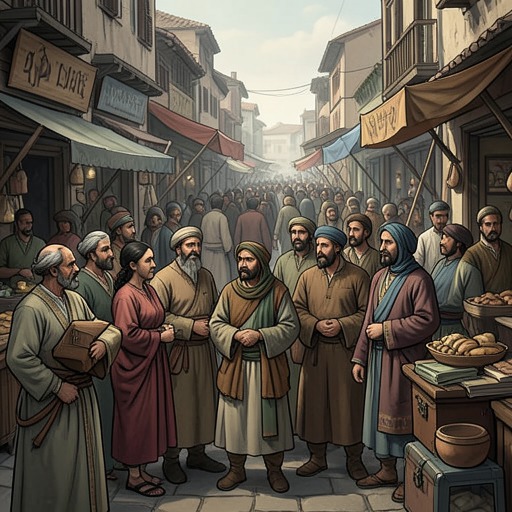
Thessalonian riot and Paul's escape to Berea
Acts of the ApostlesThe Thessalonian riot and Paul’s escape to Berea mark a turn from diverse local response to public conflict in the movement’s witness. In the account, the charge that Paul and Silas are disturbing the Roman order is both legally consequential and deeply ironic: the crowd’s actions create the unrest, even as the witness announces a world transformed by the Realm. The brief refuge in Berea does not end the danger, but a different reception there helps Paul reach Athens safely.
Causes and Background
When Paul and Silas arrive in Thessalonica, they begin their witness in a synagogue, following a pattern found elsewhere in the narrative. The responses are socially and religiously varied: a few Jewish people join the movement, along with many devout Greeks and a number of leading women. The women are described as joining on their own initiative. Together, these different groups offer a picture of the community’s widening reach, rather than a movement confined to a single social or religious constituency.
The account then turns to the majority reaction and its escalation. Many Jewish people become jealous and recruit ruffians, who stir up the city while searching for Paul and Silas. The episode is presented in a larger journey marked by reversals: an uproar in Thessalonica, a welcome in Berea, philosophical dialogue in Athens, legal disputes in Corinth, and a return to Antioch. That sequence makes the conflict one stage in a wider, uneven expansion rather than an isolated confrontation.
The Riot and the Charge Against the Mission
Unable to find Paul and Silas, the crowd attacks the house of Jason, possibly the location of a house church, and drags Jason before the authorities. The accusations claim that Paul and Silas have been turning the inhabited world upside down and proclaiming Jesus as emperor. The phrase carries a serious political charge in its setting: it alleges a disturbance of the Roman Empire’s peace, not merely a disagreement about religion.
The analysis distinguishes the allegation’s immediate and wider meanings. In the immediate events, the claim that the disciples have caused the disturbance is false: it is the mob that has disrupted the city, and the Jesus movement has no plan to dethrone Caesar. Yet the witness does challenge the established order in another sense. It announces the ending of the old age and the coming of the Realm; Jesus’ rule is described not as a bid to replace Caesar in Rome, but as rule from God’s right hand. The episode’s irony lies in the distance between the mob’s political accusation and the movement’s theological claim, even as that claim unsettles powers invested in the old world.
The Thessalonian officials receive bail money from Jason and release the witnesses. Their action follows Roman legal procedure, which, in this account, protects the witnesses from possible vigilante harm. Jason’s release does not resolve the conflict or make it safe for the missionaries to remain. Paul and Silas slip out of Thessalonica at night, leaving the immediate scene but carrying their witness onward.
Berea: Welcome, Renewed Opposition, and Escape
The travelers go to Berea, about fifty miles southwest of Thessalonica. There, their synagogue preaching meets a markedly different response: many Jewish people join the movement alongside Greeks, including women and men of high social rank. Set against the Thessalonian episode, this welcome shows that responses to the message vary from place to place; the narrative does not present Jewish audiences as uniformly hostile.
The welcome is threatened when opponents from Thessalonica travel to Berea to stir up unrest. Paul is then sent to safety in Athens. The account underscores the reversal in his circumstances by noting that Athens, though full of idols, is safer for him than the Thessalonian synagogue. Berea’s supporters therefore serve a practical role in the movement’s survival: their response is not only receptive but helps move Paul beyond the immediate threat.
Narrative and Thematic Significance
The episode places public opposition beside the movement’s social breadth. In Thessalonica, people of different backgrounds join; in Berea, a similarly varied response emerges. The riot does not erase that diversity, but it reveals the risks faced by witnesses as their message crosses communities and challenges assumptions about the established order. Jason’s house, the bail payment, the night departure, and the journey onward make the conflict concrete without turning it into a simple contest between whole religious groups.
The book’s interpretation also warns readers against treating its portrayal of hostility as a neutral account of Jewish people. Luke’s depiction of the Thessalonian opposition forms part of his polemic against unsympathetic Jewish people, while the welcome in Berea makes identification with Jewish supporters of the movement possible. Holding both responses in view matters: the narrative itself includes Jewish participants on opposing sides, and its language about the antagonists should not be generalized into a judgment about Jews as a whole.
As a pattern of witness, the episode sets fearlessness alongside protection and support. Paul, Silas, and Jason continue the work amid conflict; Roman procedure releases the witnesses in Thessalonica, while Berean supporters help Paul escape to Athens. The contrast invites attention both to opposition that follows the mission from one city to another and to the places of welcome that make continued witness possible. Its outcome is neither the end of conflict nor the collapse of the mission, but a renewed journey under changed conditions.